



The Africa Green Economy and Sustainability Institute (AGESI) has strongly welcomed the closing statement from the G77 and China at the recent COP30 summit, praising the coalition’s emphasis on climate finance, adaptation, and just transitions as essential for accelerating Africa’s role in the global green economy.
In a statement released on Saturday, AGESI asserted that the G77’s priorities, which focused heavily on the need for trillions in scaled-up funding for developing nations, directly align with the institute’s mission to reframe Africa from a continent of vulnerability to one of tangible investment opportunities.
The G77 and China rightly placed scaled climate finance at the centre of their COP30 demands. AGESI supported this call, specifically highlighting its proprietary Africa Green Opportunity Index (AGOI™) as the critical tool needed to unlock this capital.
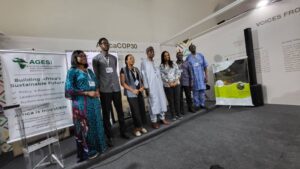
“Africa is not merely vulnerable, but investible,” the institute stated. “Through the AGOI™, we provide localised, risk-adjusted metrics that transform perception risk into opportunity.”
AGOI™ is designed to unify fragmented information and provide sector-specific guidance across key pillars like green energy, mineral value addition, and climate-smart agriculture.
AGESI believes this data transparency is key to meeting the G77’s call for finance at the “necessary scale and quality”.
AGESI echoed the group’s concern regarding insufficient resources for resilience, calling for the Adaptation Fund to be strengthened and for the commitment to triple adaptation finance to be swiftly delivered.

The institute specifically backed the establishment of the Just Transitions Mechanism, describing it as a “milestone”. AGESI urged its rapid operationalisation, emphasising the need to ensure African communities benefit directly from tangible support, noting that the AGOI™ framework is built on pillars that deliver resilience alongside inclusive growth and social equity.
Looking ahead to the second Global Stocktake (GST) in 2026, AGESI stressed the importance of embedding Africa’s economic opportunities into the global climate finance architecture.
The successful conclusion of the third WIM Review on Loss and Damage was noted as a crucial reminder that global solidarity must translate into investment flows. AGESI believes that the continent’s narrative, driven by resilience and innovation, must be central to these reviews.
Furthermore, AGESI welcomed the G77’s push for breakthroughs in technology and transparency.
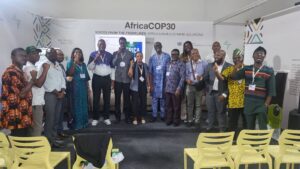
By providing credible, sector-specific data, the AGOI™ complements efforts by bodies like the enhanced Climate Technology Centre and Network (CTCN), serving as a necessary bridge between high-level policy ambition and on-the-ground investor confidence.
“AGESI applauds the G77 and China for championing equity, solidarity, and inclusion at COP30,” the statement said. “Their closing remarks affirm the urgency of reframing Africa’s narrative. With AGOI™, we stand ready to support governments, investors, and partners in unlocking capital, creating jobs, and building resilience.”
AGOI transforms Africa’s youth potential into measurable opportunities across renewable energy, minerals, and agriculture, AGESI noted, enabling policymakers to align national goals with climate resilience and inclusive growth. By quantifying employment potential, such as 10 jobs per renewable megawatt, AGOI makes the continent’s demographic advantage tangible to investors.
AGOI™ pinpoints markets where innovation, infrastructure, and workforce skills intersect to create advantages for business entry, climate finance, and alignment with global and regional strategies like the Paris Agreement and AfCFTA.
AGOI™ additionally prioritises social equity, targeting green opportunities that create quality jobs for youth and expand women’s roles in climate-smart agriculture and renewable energy.
According to the institute, it is time to move past challenge-focused narratives, pointing out that AGOI links Africa’s vast green assets with global capital seeking impact investment. It supports job creation, inclusion for marginalised groups, and value-chain integration for shared prosperity.
“Consider partnering with, investing in, or advocating for us—your support can help scale AGOI™ and accelerate Africa’s green future,” said AGESI. “Schedule a call or request the AGOI briefing deck to see how your involvement can shape this transformation and drive real change.”