


The Africa Green Economy and Sustainability Institute (AGESI) has issued a robust statement welcoming the closing remarks from the Group of 77 (G77) and China at the recent COP30 summit.
AGESI asserted that the coalition’s emphasis on climate finance, adaptation, and just transitions is a pivotal moment for accelerating Africa’s role in the global green economy, moving the narrative from vulnerability to investment opportunity.
Central to AGESI’s response is the assertion that Africa must be seen as an “investible” hub for climate capital, not merely a recipient of aid.
The institute highlights its proprietary tool, the Africa Green Opportunity Index (AGOI™), as the mechanism required to bridge the perceived risk gap. AGOI™ provides localised, risk-adjusted metrics that transform high-level policy ambition into prescriptive, sector-specific investment signals.
Dr Eugene Itua, Executive Director of AGESI, underscored this shift.
“The G77 and China have rightly placed climate finance at the core of COP30 outcomes. Africa is not a continent of risk — Africa is investible,” said Itua.
AGESI fully echoed the G77/China’s critical demands for scaled-up finance. The institute specifically stressed that the call to triple adaptation finance and the urgent need to operationalise the Just Transitions Mechanism directly align with the comprehensive framework of AGOI™’s five core pillars (Green Energy, Climate-Smart Agriculture, Circular Economy, Nature-Based Solutions, and Social Equity).
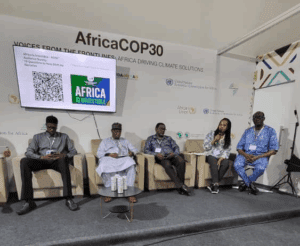
These pillars ensure that climate investments deliver both environmental resilience and inclusive growth on the ground.
The AGOI™ framework is designed to complement global efforts by providing credible data that de-risks investment decisions and strengthens policy alignment with international targets.
“AGOI™ proves that Africa’s resilience and innovation can drive global green growth,” said Charles Ozulumba of AGESI. “We call on governments, investors, and partners to act on this narrative.”
AGESI, in its statement, with a direct appeal to the international community, called for collaboration to ensure the potential unlocked by the COP30 negotiations translates into real-world impact.
The institute invited governments, investors, development partners, and philanthropies to support the rollout and scaling of AGOI™. This partnership, AGESI noted, is the essential step to unlocking capital, creating jobs, and building resilience across Africa.
AGOI transforms Africa’s youth potential into measurable opportunities across renewable energy, minerals, and agriculture, the institute noted, enabling policymakers to align national goals with climate resilience and inclusive growth. By quantifying employment potential, such as 10 jobs per renewable megawatt, AGOI makes the continent’s demographic advantage tangible to investors.
AGOI™ pinpoints markets where innovation, infrastructure, and workforce skills intersect to create advantages for business entry, climate finance, and alignment with global and regional strategies like the Paris Agreement and AfCFTA.
AGOI™ additionally prioritises social equity, targeting green opportunities that create quality jobs for youth and expand women’s roles in climate-smart agriculture and renewable energy.
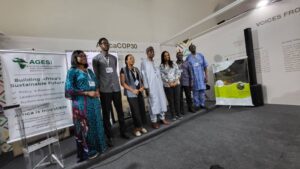
According to the institute, it is time to move past challenge-focused narratives, pointing out that AGOI links Africa’s vast green assets with global capital seeking impact investment. It supports job creation, inclusion for marginalised groups, and value-chain integration for shared prosperity.
“Consider partnering with, investing in, or advocating for us—your support can help scale AGOI™ and accelerate Africa’s green future,” said AGESI. “Schedule a call or request the AGOI briefing deck to see how your involvement can shape this transformation and drive real change.”
In September, at the Africa Climate Summit 2 (ACS 2), the African Green Economy and Sustainability Institute (AGESI) held a key meeting with United Nations Development Programme (UNDP) officials to discuss a strategic partnership to propel Africa’s green economy.
The meeting at the UNDP Pavilion on September 10 brought together Dr Eugene Itua, Executive Director of AGESI, with Dr Matthias Z. Naab, Director of the UNDP Regional Service Centre for Africa; Dr Zeynu Ummer, Director of the UNDP Resilience Hub for Africa; and Charles Nyandiga, UNDP Regional Team Leader for Environment.