



Dr Jamie Shapiro is a CEO coach, organisational psychologist, and bestselling author of ‘Brilliant: Be the Leader Who Shines Brightly Without Burning Out’. Her new book, ‘Connected Culture’, offers a groundbreaking look at what today’s organisations need to thrive, both culturally and commercially. Shapiro is the founder and CEO of Connected EC, a leadership coaching firm known for its team-based, whole-person approach to developing executives and transforming cultures. A Master Certified Executive Coach, professional speaker, researcher, expert facilitator, and certified nutritionist, she blends organisational psychology with leadership vitality and proven performance strategies.
With a PhD in Positive Organisational Psychology, an MBA, and an MS in Information Technology, Jamie brings a uniquely integrated, evidence-backed lens to leadership. Since 1998, she has coached and developed executive teams—first from within corporate leadership roles and now as a trusted advisor to CEOs navigating growth, scale, and cultural transformation. She is also the founder of the Leader and Organisation Vitality (LOV) Centre, a research institute advancing insights on leadership energy, culture health, and organisational performance. Companies are spending billions on AI to solve a productivity crisis, but they are ignoring the $10 trillion problem sitting underneath. Global employee engagement just hit its lowest point since 2020, according to Gallup’s newly released State of the Global Workplace 2026 report. And only 34% of organisations have clearly communicated how AI will change roles and required skills. In this interview with Funminiyi Philips, Shapiro provides insights. Excerpts:
Why does AI amplify what’s already in culture, for better or worse?
AI is an amplifier rather than a solution, and what it amplifies is whatever culture is already in place.
If your culture is high-trust, clear, and energised, AI accelerates learning, decision-making, and execution. If it’s fear-based, ambiguous, or politically charged, AI amplifies hesitation, protection, and silence. I’m watching this play out in real time across the executive teams I work with, same technology, same vendors, wildly different outcomes, and the variable is almost always the culture underneath. What looks like a technology gap is almost always a culture gap.
What do disengaged teams actually cost companies beyond the Gallup headline?
The headline number is productivity loss, but the deeper cost is lost capacity, and in an AI economy, that’s the one that matters most.
Disengaged teams don’t take initiative, they don’t surface ideas, they sit on decisions, work around each other, and quietly opt out of anything that requires risk. None of that shows up cleanly on a P&L, but you feel it in every meeting that should have moved something forward and didn’t.
AI doesn’t create an advantage on its own. It only creates advantage when people experiment with it, integrate it into how the work actually gets done, and bring their judgment to it. Disengagement shuts all of that down, so you can buy the technology and still get no return (on it).
What insight did you glean from the Gallup poll?
What struck me most is that we’re asking exhausted systems to transform.
The same data showing low engagement also shows record-high stress, burnout, and detachment, with managers stretched thin and teams running at capacity or beyond it. When we layer AI on top of that and expect curiosity, creativity, and innovation to follow, it rarely does. Without reframing AI as something that gives capacity back, it just lands as one more thing: one more rollout, one more learning curve, one more reason to feel behind, and people resist it before they ever engage with it, not because they’re closed-minded, but because their nervous systems are already maxed out.
The leaders getting traction are the ones who name that reality first and then position AI as a way through it rather than on top of it.
What are the concrete first moves leaders need to make before any transformation will stick?
There are three moves I’d put in order. First, change the narrative from cost reduction to capacity creation. Second, get leaders using AI personally rather than talking about it. Third, create explicit permission to experiment, including permission to be wrong out loud.
Most companies start with a strategy deck, and that’s backwards. People need to experience AI before they can believe in it, and they especially need to see their leaders experiencing it, fumbling with it, and learning in public.
Why are these necessary?
Because adoption is decided emotionally before it’s decided strategically. When people hear ‘efficiency’, ‘headcount reduction’, or ‘do more with less’, they don’t hear opportunity — they hear threat, and once a person is in threat, they protect their role, their information, and their workload instead of learning. You don’t get innovation from a system where people are quietly bracing.
What diagnostic questions should every CEO be asking?
A handful I’d start with: What are people actually hearing when we talk about AI, as opposed to what we think we’re saying? Where is fear showing up but not being named? What are people protecting right now, and why? Where might we be unintentionally signalling threat? What work is draining our people that AI could genuinely take off their plate? And the one I press hardest on, are we expanding our people, or making them feel replaceable?
The honest answers usually come from the middle of the organisation rather than the top.
How does shadow AI use reveal communication gaps?
Shadow AI is one of the clearest cultural signals a leader has, and most leaders are reading it wrong. When people are using AI tools their company hasn’t sanctioned, it’s telling you something specific: that people need more capacity than the system is giving them, that they’re moving faster than the system can keep up with, or that they don’t feel safe being transparent about how they actually work, and sometimes all three at once. It looks like a governance problem, but it’s almost always a trust and clarity problem first.
How do fear-based cultures quietly kill AI adoption?
Fear-based cultures don’t reject AI, they suppress it. People will attend the training, they’ll say the right things in the meeting, they’ll nod through the rollout, and then they won’t use it or they’ll use it in hiding, which is worse.
AI adoption requires trying something new, not knowing the answer, and being visibly wrong on the way to getting it right, and in a fear-based culture, every one of those behaviours carries a cost, sometimes overt and more often subtle. So people opt out, and leadership wonders why the investment isn’t landing.
How can companies lead through FOBO (Fear of Becoming Obsolete)?
FOBO isn’t being created by AI itself; it’s being fueled by the way leaders talk about it. When the language is dominated by cost, efficiency, headcount, and elimination, people don’t hear strategy; they hear that they are the line item, and once someone feels expendable, they don’t lean in; they guard.
The shift is straightforward, though not easy. Leaders must consistently signal that AI is not here to replace people but to expand what they’re capable of, take the work that drains them, and give them back time for the parts of their job that actually require a human. When people feel expanded, they engage; when they feel threatened, they protect, and that single difference shapes the entire trajectory of an AI rollout.
What points would you like to highlight about your latest book?
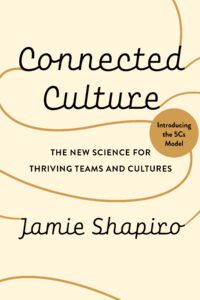
Connected Culture is about making culture measurable, actionable, and tied directly to performance, because most culture work has been none of those things.
The 5Cs — Connection, Candid Communication, Clarity, Collaboration, and Contribution — are the conditions that determine whether teams can actually execute, and they’re not soft. They’re the operating system underneath every result a team produces. AI doesn’t replace those conditions; it depends on them, and you don’t get AI transformation without cultural transformation. The companies trying to skip that step are the ones currently stuck.
What else would you like to say that we haven’t asked?
That we’re treating AI as a technology shift when it’s really a leadership shift. The companies that win this next decade won’t be the ones that deploy AI the fastest. They’ll be the ones that build cultures where people feel safe enough to learn, clear enough to act, and energised enough to bring themselves fully to the work, and that’s where AI becomes a multiplier instead of a threat. AI will amplify whatever leaders build, so the only real question is what you’re giving it to amplify.