


The discourse on accelerating sustainable development finance took a decisive turn last week as Dr Eugene Itua, CEO of Natural Eco Capital and Executive Director of the Africa Green Economy and Sustainability Institute (AGESI), discussed an analytical tool at the AADFI-ADFIAP Joint International CEO Forum 2025.
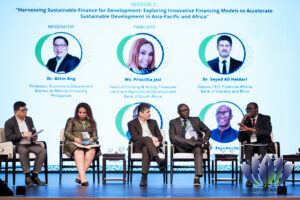
Held from October 22–24 at the Wynn Macau Hotel, the forum saw Itua honoured with a Certificate of Appreciation, presented by Thimal Perera, CEO of DFCC Bank Plc, Sri Lanka, for his “outstanding contribution” as a panellist in the session focused on ‘Harnessing Sustainable Finance for Development’, a statement by AGESI on Tuesday said.
Itua’s intervention delivered a compelling thesis: sustainable finance must evolve from being a niche innovation to a core function of mainstream risk management.
This evolution, he argued, must be anchored in three foundational pillars: establishing legal and policy certainty, embracing natural capital valuation, and adhering to auditable governance standards.
A standout moment during the session was the introduction of the Africa Green Opportunity Index™ (AGOI), a first-of-its-kind strategic dashboard designed to transform Africa’s ecological wealth and governance capacity into investable, measurable, and resilient financial opportunities.
The AGOI is considered a highly sophisticated tool that maps over $1.4 trillion in annual natural capital value while simultaneously benchmarking governance readiness across various African nations.
Itua proposed using the AGOI as a shared platform for opportunity mapping and strategic risk benchmarking between Africa and the Asia-Pacific region. He explained that Africa’s natural capital must be perceived not as a vulnerability, but as an opportunity.
“The GOI is Africa’s answer to the global capital gap. It shows where nature is bankable, where governance is investable, and where capital can flow with confidence,” said the AGESI chief.
AGOI fundamentally shifts the narrative from perceiving “Africa as vulnerable” to seeing “Africa as investable”. It is designed to meet Development Finance Institutions (DFIs) where they operate, at the critical intersection of governance, risk, and capital deployment, thereby positioning them as co-architects of global resilience, according to the AGESI statement.
The impact of the AGOI extends far beyond the DFI strategy, creating a truly collaborative ecosystem. The index engages governments by providing a strategic lens for assessing policy reform, signalling investment readiness, and aligning national development plans with global sustainability standards.
It simultaneously empowers private investors and corporates with market intelligence necessary to identify bankable natural assets and sustainability-aligned opportunities. For civil society and academia, AGOI offers a transparent platform for advocacy, research, and capacity building, ensuring that sustainability is not just a financial imperative but a shared societal mission.
Together, these stakeholders form a collaborative ecosystem where AGOI serves as the common dashboard, effectively translating ecological wealth and governance capacity into measurable, investable, and resilient development pathways across the continent.
Itua’s panel remarks further substantiated this vision by including case studies on climate legislation and sovereign investment strategies, alongside practical tools for monetising nature as infrastructure, which includes Natural Capital Accounting and forest carbon offset systems. He also detailed essential governance safeguards, including the UNDP SDG Impact Standards and ESIA/RAP compliance frameworks.
Itua called for auditable resilience, urging DFIs and investors to embed law, nature, and governance into every deal. His closing message was a call to action.
The AGESI boss said, “Let’s move sustainable finance from niche to norm. Let’s build a future that is resilient, inclusive, and bankable.”