



In this interview with Funminiyi Philips, Liane Davey discusses her new book, Thoughtload: Manage The Madness and Free Your Team To Do Great Work. Liane has spent over 25 years researching and advising teams on how to perform at their best. Known as the “teamwork doctor”, she works with teams from the frontlines to the boardroom, across industries and around the world, from Boston to Bangkok. Through her work with hundreds of teams, including 26 Global Fortune 500 companies (and counting), she has developed a practical, research-backed approach to addressing the challenges that hinder effective teamwork.
Liane is a New York Times bestselling author of You First: Inspire Your Team to Grow Up, Get Along, and Get Stuff Done and The Good Fight: Use Productive Conflict to Get Your Team and Organisation Back on Track. She is a regular contributor to Harvard Business Review and a sought-after expert for media outlets including CNN, NPR, USA Today, The Globe & Mail, and Forbes. Her work focuses on increasing productivity, strengthening engagement, developing leaders, and helping teams navigate conflict in healthier, more effective ways.
As a keynote speaker, Liane has engaged audiences ranging from 20 to over 2,000 people. Her talks combine research, real-world experience, and practical frameworks that leaders and teams can immediately implement. Known for her candid style and relatable stories, she translates leading research into actionable insights that help organisations overcome dysfunction, face challenges directly, and develop stronger, more resilient teams. Liane’s clients include Amazon, Walmart, TD Bank, RBC, AMD, MD Anderson, Google, Bayer, KPMG, Aviva, UNICEF, and SONY Interactive Entertainment. While she works across various industries, she tailors each talk to suit the specific realities of her audience.
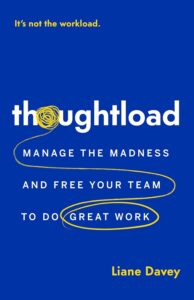
Let’s start by congratulating you on your upcoming book, Thoughtload: Manage The Madness and Free Your Team To Do Great Work. What will you say are the five takeaways from the book?
Many people are feeling burned out. That doesn’t mean they are weak or lazy. The way we’ve set up work today makes overwhelm almost inevitable. While we blame high workload for causing overwhelm, it’s more likely high thoughtload—an invisible tax on your productivity that comes from rising cognitive demands, growing emotional burdens, and shrinking energy reserves. The secret to fighting overwhelm (and to getting more done with less stress) is to lower thoughtload, not workload.
Focusing on outcomes, not activities, is the starting point for lower thoughtload. When you know what matters, budget your time and energy to the activities that will get you there. Ignoring and suppressing emotions creates drama. Instead, process what’s useful and reframe emotions into constructive actions that will move things forward. Action is the antidote to anxiety. Normalise renewable sources of energy. We need to set up work to include not only rest, but also active pursuits that energise, like working on interesting projects, connecting with like-minded colleagues, or hearing about the impact of our efforts on customers.
What specific lessons from elite athletes’ management of thoughtload, such as handling pressure and expectations, can workplace leaders apply to reduce cognitive overload in high-stakes team environments?
Elite athletes are ruthless about managing thoughtload. First, they are crystal clear on the primary outcome they’re pursuing and the very small set of second- and third-priority goals (e.g., securing sponsorships or growing a social media following). Everything else has to wait. Another key part of training and being performance-ready is that athletes continually process the emotions that arise—anxiety, disappointment, excitement, fear —all of which can detract from optimal performance. Athletes use sports psychologists to help them process their emotions so they can move through them. Finally, elite athletes are ruthless about renewing their energy to ensure they have the physical, mental, and emotional drive exactly when they need it. Athletes don’t view rest as indulgent; they see it as essential to training properly and performing at their best.
How do athletes intuitively address thoughtload in ways that corporate settings overlook, and what quick diagnostic tool could teams use to identify it?
I’m not sure that managing thoughtload is any more intuitive for an athlete than it is for an employee in a corporate setting. With a barrage of information and triggers coming at them, it takes deliberate effort to stay focused, calm, and energised. I’ve created a quick tool to help individuals assess their thoughtload and identify which component of thoughtload (attention, emotions, or energy) offers the greatest opportunity for improved performance. (Here’s) link to the assessment: https://lianedavey.com/thoughtload-quiz/
Why is attention the true currency of performance rather than time, and what immediate practices can busy executives adopt to protect it from daily drains?
The total amount of time you spend on an activity is a poor gauge of how productive you’ll be because studies show that you’re being interrupted by others every 11 minutes, by your email every five minutes, and by a notification every two minutes. Each of those interruptions acts as a cognitive speed bump, slowing your thinking and reducing your ability to do the work efficiently and effectively. Rather than setting a target for how long you will work on something, try aiming for a longer duration that you’ll attend to it without being distracted.
How do elite performers shift from willpower dependence to sustainable energy systems, and what evidence from your Fortune 500 clients shows that this boosts output?

From a neuroscience perspective, what causes confidence to build or collapse under pressure, and how can leaders create “momentum rituals” to sustain it in teams?
Confidence builds when your brain feels the environment is predictable, that you are competent, and that you’re positioned for success. To foster that feeling, leaders need to ensure their teams have clear goals, the resources and capabilities to deliver, timely feedback to enable course correction, and positive consequences that demonstrate progress. Stacking up a series of small wins helps avoid the threat response and the downward spiral that often accompanies it.
For workers, the issue is that thoughtload has never been higher. With the prevalence of matrix organisations and cross-functional teams, employees face more (and often competing) priorities. Each of those cross-functional teams brings extra meetings, more Slack or Teams channels, and new characters with their own motives and idiosyncrasies to deal with. And home lives are equally frenetic for many people with relentless expectations for child- and elder-care and less time unplugged and stress-free.
How does visualisation and mental rehearsal practically reduce thoughtload during high-stakes moments, and what five-minute exercise can teams use pre-meeting?
| Feature | Traditional Workload | Davey’s “Thoughtload” |
| Focus | Volume of tasks and hours worked. | Cognitive, emotional, and energy demands. |
| The Tax | Physical fatigue. | Attention drains and “cognitive speed bumps.” |
| Solution | Time management / Triage. | Lowering thoughtload; outcome-focused energy. |
| Antidote | Rest/Vacation. | Action, emotional reframing, and renewal. |
What keeps you going as a person and as a professional?
For me, the most important thing is being clear on the problem I’m trying to help with in the world. I’m focused on making work a more meaningful part of people’s lives, particularly in making teamwork work. From there, I commit to keeping my thoughtload as low as possible and directing as much energy as I can to doing that important work. Finally, I take restoration as seriously as work—tapping into sources of energy from being active, spending time with family and friends, and prioritising rest. I try to take my own medicine when it comes to thoughtload.
What more can you tell us about this book?
I wrote Thoughtload for all the managers who feel like their teams are drowning but don’t know how to help while they’re trying to keep their own heads above water. This book is meant to be a life ring, keeping you afloat. It’s got all the insights you need to first lower your own thoughtload and then to help your team members do the same. All that, and a whole website of resources with activities, scripts, and tools to help you put the ideas into practice.