



For millions of African livestock farmers, losing an animal isn’t just a financial setback—it’s a threat to their family’s food security, education, and very livelihood. The core problem has always been two-fold: preventable animal diseases and a crippling lack of access to care due to vast distances.
But a revolution is underway.
Meet Vet Konect Ltd., a trailblazing digital animal health company that is radically challenging this status quo. Recognised as a finalist in the prestigious Innovate for Impact Challenge, Vet Konect is armed not with traditional equipment, but with the continent’s most widespread tool: the mobile phone. By cleverly leveraging rising mobile connectivity, including simple USSD codes for feature phones, and layering on the intelligence of AI, Vet Konect is on a mission to ensure that every livestock owner in Africa is connected to professional veterinary services. This isn’t just about treatment; it’s about building a crucial digital bridge that delivers resilience, economic opportunity, and what the company calls “social protection” to the rural communities who need it most. In this exclusive interview with Funminiyi Philips, Terese Shadrach Akpem, Founder and CEO of Vet Konect Ltd, delve into how his organisation is proving that the future of African agriculture is not only digital but deeply people-centred, tackling a foundational challenge to unlock unparalleled possibilities for millions.
Congratulations on being recognised as a finalist in the Innovate for Impact Challenge! Could you please tell us about Vet Konect Ltd.’s mission and vision?
Thank you very much. Vet Konect is a digital animal health company committed to addressing the complex problems of preventable animal diseases and limited access to animal care through the leverage of mobile connectivity and AI. We are on a mission to ensure that every livestock farmer on the African continent is connected to animal care. We are guided by a vision where no animal owner across Africa lacks access to animal care and social protection, regardless of the barriers of distance.
How does Vet Konect’s technology leverage mobile connectivity and AI to enhance animal healthcare in Africa?
At Vet Konect, we see both mobile connectivity and artificial enablers that offer us tremendous opportunities to close a service deficit between animal health professionals and livestock farmers who require their services in order to also sustain their livelihoods. Mobile connectivity across Africa is on the rise, meaning on average, 60% of the continent owns a smart or non-smart mobile device, which offers us the barrier of entry through which we layer our offering for them to access through such devices without any additional hardware requirements. Artificial intelligence fits in to further advance productivity both in disease management and production processes for the farmers.
What specific challenges do livestock farmers in Africa face, and how does Vet Konect address these issues?
While livestock farmers across Africa are confronted with a plethora of challenges, we can effectively reduce them to the most fundamental ones to two principal ones: preventable animal diseases and lack of access to animal care. This forms the key drivers for losses incurred by livestock farmers, which is what inspired me to address the problem from this lens. Because a farmer who has access to animal care services, as a benefit of such access, gets advice and support on better and quality livestock breeds, feeds, right production practices and so on to ensure success for them.
Can you share some success stories or case studies of farmers who have benefited from Vet Konect’s services?
Our reach and impact on livestock farmers is quite diverse. From poultry farmers who leverage our platform to connect to animal professionals who never realised they had a professional within reach and had incurred losses in the past, to communities whose animals get vaccinated against diseases by our Vet Konect Champions, whose impact is far-reaching across rural communities. Then there are the animal health professionals who today are also getting increased visibility to provide more value for animal owners than they had in previous times.
How does Vet Konect’s solution contribute to global food security and sustainability?
Africa is home to over 600 million animal owners whose work supports over 1.4 billion livelihoods across the continent. If you think about it in terms of families and homes, these are children, men and women who have access to animal protein sources because of these livestock. Then there is the income that also comes from trading these livestock to pay for health care, education, or to get something critical to advancing through life. Coming from a background of livestock farmers, where I had the privilege to witness my grandmother slaughter and sell pork in our village, was probably the earliest moment I was inoculated by the transforming power of livestock production, because before my birth, that source of livelihood ensured she paid my father and his siblings through school.
What sets Vet Konect apart from other agri-tech startups in Africa?
I believe every solution sets out to solve a unique problem, and I have read about a ton of them. What I believe sets us apart as a startup solution is the scale of our ambition and approach to solving a foundational problem, which, when addressed, ensures a lot of things fall in place from there forward. We are also very people-centred in our approach to ensuring that what we do empowers others to do more. Nothing holds people together than what provides collective liberation for everyone.
How do you see the agri-tech landscape evolving in Africa, and what role can Vet Konect play?
Africa is truly the new frontier, and I do not doubt it. This way is coming, and at Vet Konect, we are committed to riding on this wave to drive home solutions that unlock unrivalled possibilities for all players across the livestock ecosystem. It is true that when agriculture is spoken about, you get to hear more about crops than livestock. In fact, several studies show that investment in agriculture in the last 20 years has tilted to crops in a ratio of 65% to 35% for livestock. I am committed to seeing things improve as we go forward. There is no sustainable path forward if we do not see both sides as complementary to each other, which is why I do my best to serve as a “lone voice” when I am in rooms discussing the path forward for agriculture, because we cannot afford to leap forward with such an imbalance.
What are the biggest hurdles you’ve faced in scaling Vet Konect, and how have you overcome them?
I started building Vet Konect with absolutely no financial backing. I leveraged my social network of friends who helped in turning what I had sketched on paper into a mobile platform, which I told them would change how we access animal care services. From that point to date, I have thought more about what I have around me than what is missing. That mindset is what has given me the stamina to attract the talent that, despite little or no financial benefit, have joined us to build this vision. With that said, I am also aware of the fact that our journey would have been much faster and we would have achieved more with more finance and structured mentorship support because a lot of our growth metrics depend on reaching out to the animal owners in their numbers, strengthening our digital infrastructure and providing decent remuneration for the team working daily to keep the lights on. It is why I am eternally grateful to my entire team for being believers in what we are doing at Vet Konect.
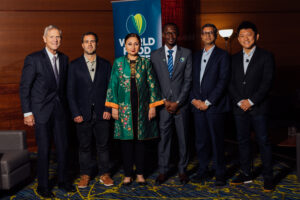
Photo Credits: World Food Prize Foundation
How does Vet Konect’s technology impact the livelihoods of smallholder farmers and rural communities?
Rural communities face a unique challenge of access above all else. They are mostly hard to reach and therefore are discounted from the rest of the world, but that does not mean they are invisible. I am a firm believer that Africa’s rural poor hold enormous potential to improve our collective lives. When we built the USSD codes to reach farmers in rural communities, that was the exact thinking that guided us to ensure that, with their feature phones, they should access the basic services to keep them going. Our early learning and warning system is also providing key support on disease outbreaks and veterinary advisory to further build this resilience.
Can you discuss the potential for Vet Konect’s solution to be replicated in other regions or countries?
Currently, we have a growing network of animal health professionals across more than 8 African countries. The goal is simply to build a connected system across Africa, where I envision a future where this network evolves into a force that connects every community across the continent. So our approach to this is to get the supply side, which are animal health professionals, organised and empowered rightly, which will now open them up to livestock farmers across their regions to offer value to them. We also see partnerships and collaborations as a strong path to that success for us as a company, and we are also actively exploring these.
How does Vet Konect collaborate with other organisations or stakeholders in the agricultural sector?
Collaborations are a huge part of our mode of operation. For instance, we have a partnership with an input supply company with the goal of providing input supply for livestock farmers in our network. There is also the situation where we are building partnerships with both government institutions and livestock associations. Earlier in the year, we powered what was the first livestock summit in the history of Benue state. That was a classical example of cross-cutting partnerships at play. We aim to sustain this approach even as we deepen our work, especially in connecting livestock farmers and animal health professionals to sustainable financing models.
What are the most pressing animal health issues in Africa that Vet Konect is working to address?
Two, actually, that are intricately connected: preventable livestock diseases and a lack of access to animal care. Adjoining challenges of equal importance, as we are now working forward, are ensuring farmers are getting the right inputs to produce with, accessing the right support and of key importance to us is that of plugging in the element of social protection, which to us entails both access to finance and insurance, which penetration for both currently stands at less than one per cent. Things will have to change very drastically, and we are here to work with anyone with the ambition and passion to change things for the better.
What’s next for Vet Konect in terms of growth, innovation, and impact?
Going forward, we are committed to improving our digital solution across both online and offline elements to be more responsive and value-driven. We are also aggressively pursuing financial sustainability through our business models to ensure we exit the phase of over-dependence on external support, which will allow me to focus on internal growth. Partnerships are a key next step for us. Securing partnerships with international organisations whose vision is aligned with ours with respect to animal care delivery and social protection for livestock farmers and animal health professionals is a worthwhile effort that we continue to pursue. All these feed into our target to reach five million livestock farmers across the continent by 2030. It’s a tall order, but I am confident that is the kind of mindset that Africa deserves at this point. We must all be in a hurry to move past the era of “Africa as a continent of potential” to one that is living out that potential.